If you have ever had a guest complain that the lobby smells like last night’s fry-up, you already know the real problem with grease trap odours – they do not stay politely in the kitchen. They travel through risers, service corridors and lifts, then show up right where reviews are written. The frustrating part is that many sites are “doing the right things” on paper: the trap is installed, it is being pumped, and the kitchen has extraction. Yet the smell persists.
A grease trap odour control unit is meant to break that chain. But not all units work the same way, and the wrong choice can leave you paying for consumables, chemistry, or maintenance visits without actually reducing complaints. This is a practical look at what drives grease odour, what an odour control unit can realistically do, and how to select a solution that performs in day-to-day operations.
What a grease trap odour control unit is actually fighting
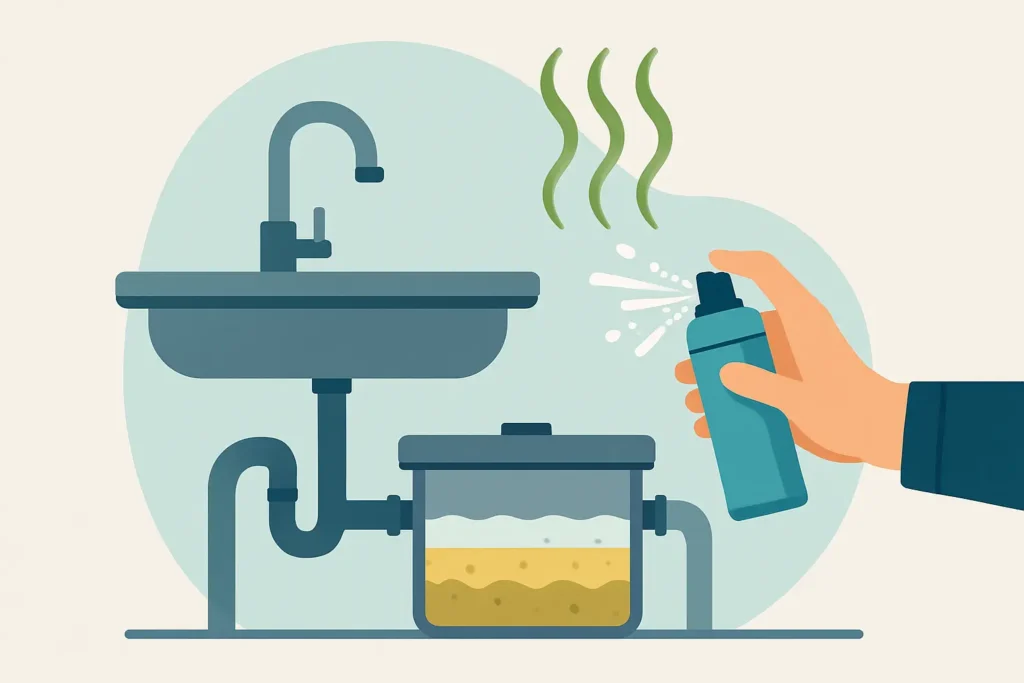
Grease traps are designed to intercept fats, oils and grease (FOG) before they hit the drainage network. The odour is not “grease” as such – it is the by-product of bacterial activity as trapped organics break down. That process releases a cocktail of sulphur compounds and volatile organic compounds (VOCs) that are very detectable at low concentrations.
There are three common reasons odours become chronic.
First, the trap is functioning, but the retention time and temperature favour rapid breakdown. Warm kitchens accelerate it. Second, the trap or connected pipework is holding residual biofilm. You can pump out the solids and still leave an odorous lining that off-gasses continuously. Third, airflow is carrying odours out of the system and into occupied areas. A small negative pressure in a corridor, a poorly sealed access cover, or a dry floor drain can turn “contained” into “broadcast”.
That is why odour control at the grease trap is partly about chemistry and microbiology, but just as much about pressure, ventilation and building operations.
Where odour control units sit in the system
A grease trap odour control unit is typically installed at the vent line, the lid/cover interface, or in the immediate vicinity where odorous air is escaping. In plain terms, it either treats the air coming off the trap or prevents odours from leaving in the first place.
The best results come when the unit is considered part of a wider control strategy: trap sizing and placement, cleaning regime, drain seal integrity, and local extract performance. If your extract is underperforming, you can be pulling odours into the space faster than any treatment device can neutralise them.
Types of grease trap odour control unit and the trade-offs
There is no single “best” technology for every site. The right answer depends on your constraint: space, maintenance capacity, allowable emissions, and how quickly you need the odour to drop.
Carbon filtration: simple, but it loads up
Activated carbon units are common because they are straightforward and familiar. They adsorb many VOCs and can be effective when odour loads are moderate and airflow is controlled.
The operational issue is predictability. Carbon performance drops as it saturates, and grease trap odours are not a gentle, consistent load. A busy Friday service can overwhelm a small carbon bed, and by the time you smell it, the media is already spent. You also inherit a consumables programme: replacement intervals, stockholding, and disposal.
Carbon can still be the right choice where you have stable airflow, good pre-separation, and a team that will actually change media on schedule.
Chemical dosing and bio-additives: helps the trap, not always the air
Dosing systems add enzymes, bacteria, or chemicals into the trap or drains to reduce build-up and slow the breakdown cycle. When correctly managed, they can reduce solids and improve pump-out intervals.
The limitation is that dosing is not an air treatment method. It can reduce odour generation, but it does not directly neutralise odorous air that has already escaped into a corridor, bin room or lift lobby. If you have odour complaints outside the kitchen footprint, dosing alone rarely closes the loop.
Masking agents: quick, but reputationally risky
Fragrances and counteractants can suppress perception temporarily. They do not remove the source compounds and can create a new problem: guests interpret “scented” air as an attempt to cover poor hygiene.
In hospitality and healthcare environments, the safest strategy is almost always neutralisation rather than perfume.
Ozone generators: aggressive, but not a fit for occupied spaces
Some operators reach for ozone because it can oxidise odorous compounds quickly. The problem is that ozone is not compatible with safe continuous use around people at meaningful concentrations. In GB operations, you need to be able to run systems 24/7 without turning rooms or corridors into controlled zones.
If your odour control unit requires staff to leave the area, put up signage, or schedule treatment windows, you are buying a process – not a solution.
Bipolar ionisation: active neutralisation with low upkeep
Bipolar ionisation generates positive and negative oxygen ions that react with VOCs and odorous compounds in the air, breaking them down and reducing the intensity of smell without masking. In practical terms, this is attractive for grease trap odour issues because the complaint happens in the air people breathe, not just inside the trap.
The key is safety and engineering quality. Not all ionisers are equal, and procurement should be driven by credible zero-ozone verification such as UL2998, and electrical safety standards such as UL867. Without that, you cannot confidently deploy continuous treatment in public-facing areas.
A well-specified ionisation approach can be deployed as a local wall-mounted unit for the problem corner where odours leak, or in-duct to treat a wider zone that includes kitchens, service corridors, refuse rooms and adjacent washrooms. That flexibility matters in real buildings where odour pathways rarely follow neat boundaries.
How to choose the right unit for your site
Selection gets easier when you stop thinking in product categories and start thinking in constraints.
If your main constraint is “we have no manpower for media changes”, avoid solutions that rely on frequent consumables. If your constraint is “we cannot risk compliance or guest exposure”, rule out ozone-based approaches and insist on recognised zero-ozone certification for any active air treatment.
If the odour is localised at the trap access cover, you may succeed with a small dedicated unit combined with proper sealing and drain trap maintenance. If the smell is showing up at the lift or the guest corridor, it is telling you air is moving – and your solution must treat the air in the occupied zone or intercept it in the ductwork.
Also be honest about load variation. A unit that looks fine at 10am can fail at 8pm. Size for peak service conditions, not average.
Installation realities that decide outcomes
Odour control devices fail most often for boring reasons.
Airflow is one. If a unit is installed where there is no meaningful air movement, it may not contact the odorous air. Conversely, if airflow is too high for the treatment capacity, odours pass through untreated. This is why specifying by coverage and airflow rate is not sales fluff – it is the difference between “works on day one” and “never really worked”.
Sealing is another. A grease trap with a poorly seated cover, degraded gasket, or missing fasteners will leak continuously. Treating the air can reduce complaints, but you are still feeding the problem. Fix the mechanics as part of the project.
Cleaning regimes also matter. If biofilm is left in connected pipework, your “source” is larger than the trap. A good operator focuses on the entire odour circuit: trap, inlet/outlet, nearby floor drains, and any rarely used fixtures that dry out.
What good performance looks like (and how to measure it)
Odour control is often managed through complaints, which is too slow and too political. Operators want faster feedback.
A simple approach is to define a baseline: where odours are noticed, at what times, and under what operating conditions. Pair that with objective IAQ indicators where possible, such as VOC trends, PM2.5 (useful as a general ventilation sanity check), and maintenance call-outs related to drains, mould or persistent smells.
The goal is not perfection in a laboratory sense. The goal is operational: fewer odour incidents, faster recovery after busy periods, and fewer spaces taken out of service because “the smell is back”.
A note on engineered ionisation for grease odour pathways
Where grease trap odours are affecting guest-facing zones, a source-only approach can be too narrow. Treating the air in the pathway is often the faster win.
That is where engineered bipolar ionisation systems designed for continuous commercial use can make sense, particularly models built around Glass DBD tube technology for high ion output and durability without charring or smouldering. If you are evaluating this route, insist on UL2998 zero-ozone verification and match the unit to the square-metre coverage of the affected zone, not just the kitchen footprint. PurAire designs systems specifically for these commercial realities, from small wall-mounted units for service corridors to HVAC-integrated solutions for whole-building treatment – details at https://Www.PurAire.sg.\
The decision that saves the most money
The cheapest grease trap odour control unit is the one that does not create a second maintenance programme. Every consumable, chemical top-up, and reactive call-out is a hidden cost, and in hospitality it turns into a revenue cost when areas are avoided, rooms are moved, or guests complain publicly.If you want an odour strategy that holds under peak service, choose a solution you can run continuously, safely, and predictably, then support it with basic mechanical discipline: seals intact, traps not drying out, and extraction doing its job. Your air should not be a warning sign. It should be evidence that operations are under control.
If you want an odour strategy that holds under peak service, choose a solution you can run continuously, safely, and predictably, then support it with basic mechanical discipline: seals intact, traps not drying out, and extraction doing its job. Your air should not be a warning sign. It should be evidence that operations are under control.