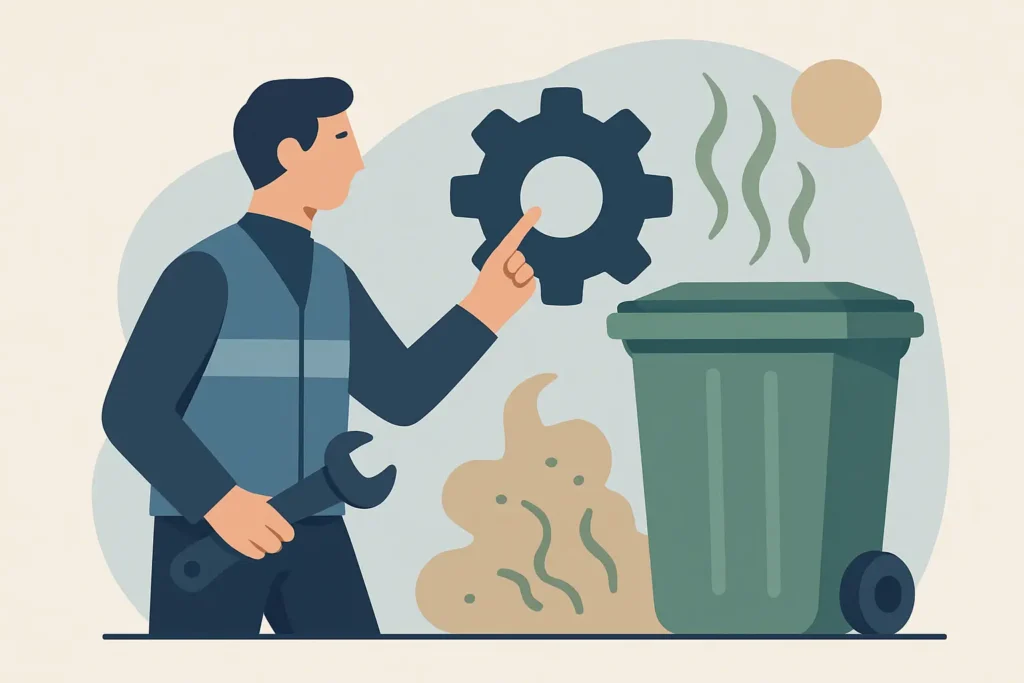
The bin store is the one room nobody wants to talk about – until the complaints start.
A whiff in the service corridor. A sour note in the lift lobby. A persistent “rubbish” smell that somehow reaches the reception desk even though the doors are shut. By the time it’s obvious, it’s already affecting guest experience, staff morale, and sometimes even pest pressure.
If you’re specifying or fixing a bin store odour control system, the goal is not “make it smell less bad”. The goal is to stop odours travelling, stop them building up, and reduce the biological load that creates them in the first place.
What a bin store odour control system is really dealing with
Bin stores are not a single-odour problem. They’re a mixed plume of volatile organic compounds (VOCs) from food waste, leachate, packaging residues, and cleaning chemicals, plus bioaerosols from bacteria and mould. Add heat, humidity, and poor air movement, and you’ve built a perfect odour generator.
This is why masking sprays fail. They treat perception, not chemistry. They also train staff to “top up” the smell, which increases chemical use and can create its own complaints.
It’s also why simple extraction can be hit and miss. You can pull air out, but if odour compounds are continually being produced, extraction becomes an energy cost that never catches up – and if the room goes negative in the wrong way, you can drag odours through gaps and door undercuts into adjacent areas.
A workable system starts with two questions:
- Where is the odour being generated and how fast?
- Where is the air going when doors open, fans cycle, and lorries arrive for collections?
Start with airflow – because odour travels on air
Air management is the backbone of any bin store odour control system. Without it, every other technology is working against uncontrolled movement.
You typically want the bin store to be slightly negative to surrounding areas so odours stay contained, but “negative” is not the same as “starved”. If you extract without providing make-up air, the system hunts for replacement air through the easiest path: corridors, risers, lifts, and ceiling voids. That is how bin-store odours turn into a building problem.
The practical target is controlled extraction with a known, intentional make-up air path. That might be a louvred door, a dedicated supply grille, or a ducted supply depending on layout and fire strategy. The point is predictability.
It depends on the site, but you’ll usually see better containment when:
- Extraction runs continuously at a baseline rate, rather than only on a timer.
- Boost is available for peak loading and after collections.
- Door seals and thresholds are treated as engineering details, not housekeeping chores.
If odours are reaching the lift lobby, treat it as an airflow failure until proven otherwise.
Why “filters only” rarely solve bin store odours
HEPA filtration is excellent for particulates, but bin store odours are primarily gas-phase VOCs. A HEPA filter does not remove smells. It can reduce some bioaerosols that carry odour, but it won’t neutralise the volatile compounds that people actually notice.
Activated carbon can reduce odours, but performance depends on bed depth, dwell time, humidity, and the specific VOC mix. In a humid bin store, carbon can saturate faster than expected, and once it’s spent you’re paying for replacements, disposal, and the operational pain of monitoring.
That doesn’t mean carbon is useless. It means carbon is a consumables strategy. If your team wants low maintenance and predictable cost, relying on carbon alone is often the wrong long-term bet.
Chemical dosing and fragrance: quick wins that become permanent problems
Enzyme dosing, perfumes, and “odour counteractants” can be useful as part of cleaning, but they are not a bin store odour control system.
The trade-off is simple: they create a dependency on labour and consistency. Miss a day, change a supervisor, or get a busy weekend, and the smell returns immediately. Worse, many fragrances read as “cover-up” to guests and residents. The complaint shifts from “rubbish smell” to “rubbish smell mixed with perfume”, which is harder to defend.
If you use chemicals, use them to reduce the source (biofilm and residue), not to rewrite the air.
The case for active air treatment in bin stores
Bin stores benefit from technologies that work continuously and treat both gases and biological contaminants. That’s where active ionisation is often a better fit than passive filtration.
Bipolar ionisation generates positive and negative oxygen ions that react with VOCs and other odorous compounds in the air, changing their structure so they no longer smell the same way, while also reducing airborne microbial activity. In operational terms, you’re not waiting for air to pass through a filter – you’re treating the space.
Two cautions matter here:
First, safety. If you’ve ever seen an “ozone generator” suggested for bin stores, treat it as a red flag. Ozone is a respiratory irritant and not something you want in an occupied commercial building, particularly near back-of-house routes that staff use all day.
Second, quality of the ionisation method. Not all ionisers are built the same, and not all of them are engineered for commercial duty cycles.
What to look for in a bipolar ionisation solution
If you’re evaluating ionisation as part of a bin store odour control system, focus on evidence and engineering, not marketing adjectives.
Start with zero-ozone assurance. Look for UL2998 (zero ozone) and, where applicable, UL867 for electrical safety. These are procurement-friendly standards because they reduce the guesswork about by-products.
Then look at the ion generation method. Glass DBD (dielectric barrier discharge) tube technology is designed to produce high volumes of ions with stability over time. It also avoids the tube failure modes you see in some composite designs that can char or degrade under harsh conditions.
Finally, look at the maintenance model. In a bin store you want silent, 24/7 operation without filters and without staff needing to “do something” every shift. If a solution depends on consumables, ask who will own replenishment and what happens when it’s missed.
One practical path facilities teams take is using a professional-grade bipolar ioniser sized to the bin store volume and odour load, either as a wall-mounted unit for local treatment or integrated in-duct if the store is mechanically ventilated. A brand example is PurAire, which positions Glass DBD bipolar ionisation with UL2998 and UL867 certifications for continuous commercial odour neutralisation without consumables.
Bin store odour control system design: what “good” looks like on site
A strong setup is rarely one device on a wall. It’s a small system where each part covers a failure mode.
Airflow containment comes first. You establish negative pressure relative to adjacent areas, but with a deliberate make-up path so you’re not pulling odours into the building fabric.
Active treatment comes next. Ionisation in the room treats odours where they form and where doors open. If you have a ducted extract, treatment can also be positioned to reduce odour in the airstream and limit smells at discharge points, subject to design and compliance requirements.
Cleaning becomes easier, not more frequent. When the air is treated continuously, residue still matters, but the room stops “recovering” its smell every few hours. That’s when a cleaning plan actually holds.
If you want a quick reality check, judge the room after a collection. The worst odour events often happen when bins have been moved, lids left open, and warm air surges in. A system that only works when the room is undisturbed isn’t doing the job.
It depends: common bin store variables that change the answer
Two sites can have the same floor area and completely different odour behaviour.
Waste profile matters. A hotel with heavy food waste and room service generates a different VOC mix from an office tower with mostly dry waste. Grease, dairy, and meat residues are persistent. So are leaked liquids that soak into grout lines.
Humidity and temperature matter. Warm, humid spaces accelerate microbial growth and volatilisation. If your bin store is near plant rooms or receives solar gain, odour control needs more than “standard extraction”.
Neighbouring spaces matter. If the bin store shares a wall with a staff corridor, laundry route, or service lift, the tolerance for odour migration is basically zero. In that scenario, you design for containment first, then treat the air aggressively.
Finally, operating discipline matters. If lids are left open, waste is stored outside bins, or collections are inconsistent, you can still control odours – but you’ll need more capacity, and the building will pay for that one way or another.
Measuring success in operational terms
Facilities teams don’t need vague promises. You need outcomes you can defend.
You’ll know your bin store odour control system is working when odour complaints drop to near zero, the smell does not hit you at the door, and adjacent areas (especially lifts and corridors) stay neutral even during peak waste handling. Maintenance should also get quieter: fewer call-outs about “a smell somewhere”, fewer reactive deep cleans, and fewer pest-related escalations driven by odour cues.
If you want to be performance-obsessed about it, track complaint frequency and time-to-resolution before and after implementation. Odour is subjective, but patterns are not.
The most valuable result is simple: when back-of-house stops leaking into front-of-house, your building feels better run. That shows up in staff confidence, guest reviews, and the number of problems that never become incidents.
The closing thought that matters: treat the bin store like any other critical plant space. Engineer the airflow, choose active treatment that’s certified for occupied buildings, and make the room boring again – because boring is what “fixed” smells like.