A guest says the room “smells damp”. The extractor’s running, housekeeping has sprayed fragrance, and the carpet has been shampooed twice. Yet the complaint keeps coming back – and now the room is blocked, revenue is bleeding, and engineering is being asked for a solution that actually sticks.
That is the real test for bipolar ionisation odour removal: not whether it can make a space smell nicer for ten minutes, but whether it can neutralise odour chemistry in the air and on surfaces fast enough to protect occupancy, reputation, and maintenance time.
What bipolar ionisation odour removal actually does
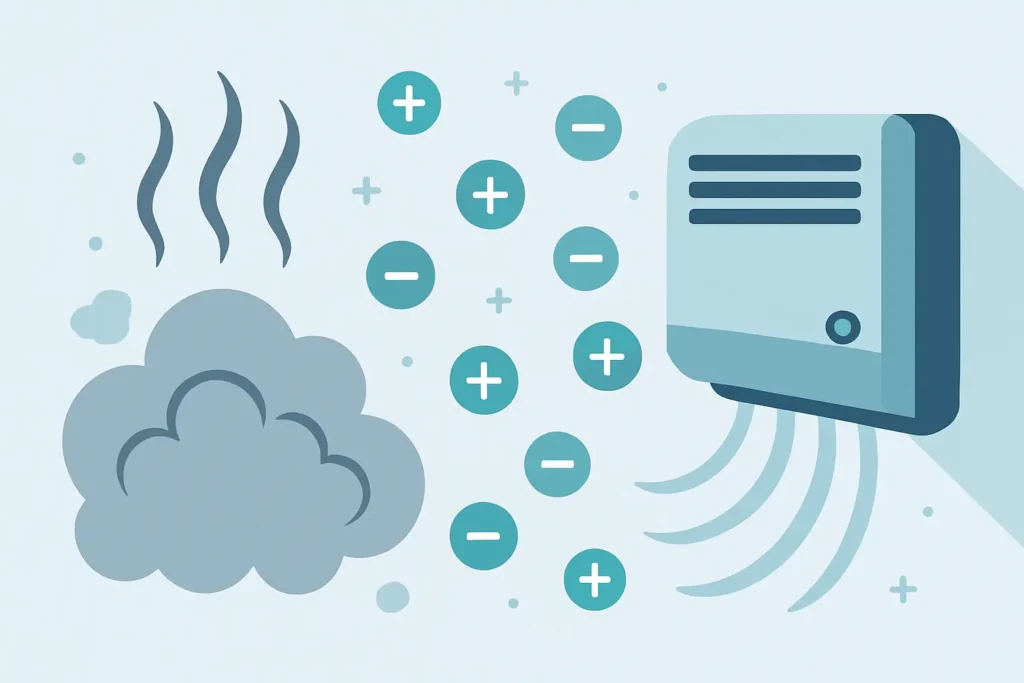
Bipolar ionisation systems generate both positive and negative oxygen ions. In practical terms, those ions disperse into the treated space and react with odour-causing molecules and some airborne contaminants. Instead of “covering” a smell, you are aiming to change the chemistry so the odour is no longer volatile, no longer detectable, or both.
Most persistent commercial odours are not a single thing. A “musty” guest-room complaint often includes mould-related microbial volatile organic compounds (VOCs), moisture-driven off-gassing from soft furnishings, and trapped organics in coil fins or condensate trays. A bin room smell can be a mix of sulphur compounds, ammonia, and fatty acids. Toilets can swing between urine-based ammonia notes and drain gases. If you only filter particles, you leave most odour molecules untouched. If you only mask, you train guests to distrust you.
Bipolar ionisation is designed to be active. Ions move with the air, reach corners, and keep working when the door closes. That is why operators choose it when the complaint is not “dusty” but “this place smells wrong”.
Why odours keep returning in real buildings
Odour is usually a system problem, not a single dirty surface. Hotels and facilities see the same patterns repeatedly.
First, moisture and biofilm in HVAC components: fan coil units, drain pans, insulation, and duct liners can become odour factories. Second, porous materials: curtains, carpet underlay, and upholstered headboards can absorb VOCs and release them again when humidity rises. Third, airflow: negative pressure in toilets and corridors can pull smells from risers, refuse areas, or adjacent units.
This is where “it depends” matters. If a smell is driven by an active leak, sewage fault, or soaked subfloor, no air technology should be sold as a substitute for fixing the source. But once the physical fault is repaired, bipolar ionisation can dramatically speed up the return-to-service time because it targets what remains – the residual odour molecules and the off-gassing that keeps a room unsellable.
The technology question: why some ionisers perform better
Not all bipolar ionisers are built the same. The performance differences come down to how ions are generated and how reliably the system holds output over time.
A common issue in the market is tube degradation. Some composite or multi-core designs can char or deteriorate in harsh conditions, which is exactly where you need stability: warm, humid fan coil compartments; 24/7 operation; and spaces with cleaning chemical vapours.
Glass DBD (dielectric barrier discharge) tube technology is engineered for high ion output with long service life. It is a more robust approach for commercial duty cycles because glass tolerates heat and does not smoulder. For an operator, this is not a lab detail – it is the difference between “it worked for a month” and “it keeps working through peak season”.
Safety: the ozone conversation you cannot avoid
Facilities teams are right to ask about ozone. Ozone generators have been misused for “shock treatments” in rooms, and the reputational and compliance risk is obvious: you cannot run them around people, and you cannot afford uncertainty in occupied spaces.
A professional bipolar ionisation deployment must be zero-ozone by design and verified by recognised standards. Look for UL2998 (zero ozone emissions) and, where relevant, UL867. That is how you separate a continuous, occupied-space solution from a device that creates a safety management problem.
This is also why bipolar ionisation should be discussed alongside ventilation rates and building pressure, not as a magic box. When you treat air continuously without generating ozone, you can run 24/7 without blocking rooms or evacuating areas.
Where bipolar ionisation odour removal shines
Guest rooms and serviced flats
For hospitality, the win is speed. When a room has a stale smoke residue, food odour, damp notes, or “previous guest” smells, bipolar ionisation can reduce the time required to reach a neutral smell profile. That translates into fewer compensation conversations, faster turnover, and more sellable inventory.
Portable units are often used for rapid recovery, while wall-mounted units suit recurring problem rooms where you need a consistent baseline without adding labour.
Toilets, lift lobbies, and small high-complaint zones
These are compact spaces with high perception risk. A lift that smells of rubbish or disinfectant mix will get mentioned in reviews because everyone passes through it. A wall-mounted ioniser is a practical tool here because it treats continuously, quietly, and without consumables.
Refuse rooms, loading bays, and back-of-house
Back-of-house odours migrate. If your bin centre smells, your corridors will eventually smell. Ionisation is not a substitute for waste discipline, but it can reduce the intensity and spread while you maintain normal operations.
In-duct and HVAC-integrated deployments
If odour is building-wide or rooted in HVAC, treat the air stream at the source. In-duct bipolar ionisation can reduce microbial growth drivers in coils and drain pans and help cut the “musty AC” profile that returns after every deep clean. It also supports consistency across floors, which is what operators need when complaints are scattered and hard to reproduce.
How to evaluate it like an operator, not a hobbyist
You do not buy air treatment for the technology label. You buy it for fewer complaints and fewer blocked rooms. That means evaluation should be operational.
Start with the complaint map. Where are odours reported, at what times, and in what weather? If smells spike during high humidity or when AC starts up, suspect HVAC and soft furnishings. If it spikes during refuse collection or kitchen prep, suspect back-of-house migration and pressure differentials.
Then size by volume and airflow reality, not brochure optimism. Coverage should be stated in square metres for a defined ceiling height and application type. A compact toilet and a high-ceiling lobby are different worlds.
Finally, ask what “maintenance” really means. If a system claims to be low-maintenance but needs frequent consumables or tube replacements, the cost is not just parts – it is labour, access, and downtime. Professional-grade ionisation should be designed for long tube life and continuous operation.
Bipolar ionisation vs HEPA, UV, PCO, and masking sprays
HEPA filtration is excellent for particles. If your problem is dust, allergens, or visible haze, HEPA has a clear role. But most odour molecules are gases and VOCs that pass straight through particle filters. You can run the fan harder and still not neutralise the smell.
UVC is useful for coil irradiation and targeted microbial control, but it is line-of-sight and does not actively treat the whole room air volume unless designed for it. It can be part of a strategy, not necessarily the odour fix on its own.
PCO devices vary widely. Some create by-products you do not want in occupied spaces if not engineered correctly. If a supplier cannot speak clearly about by-products and safety testing, do not gamble in a hotel or clinic.
Masking sprays and fragrances are the fastest way to lose trust. Guests interpret fragrance as cover-up, and sensitive occupants can complain about the scent itself. Operationally, it increases housekeeping workload and does not solve the root.
Bipolar ionisation sits in a different category: active, continuous treatment aimed at neutralisation rather than concealment, with the right safety standard being non-negotiable.
What results should you realistically expect?
You should expect a meaningful reduction in odour intensity and persistence, often quickly, provided the source is not still actively generating at high volume (for example, an ongoing sewage leak). In hospitality terms, the goal is simple: rooms that stop getting re-flagged after cleaning, and corridors that keep a neutral smell profile through high occupancy.
You should also expect fewer mould and mildew-related maintenance calls when the deployment is matched to the environment, particularly in humid climates or buildings with chronic condensation. That does not replace proper drainage, insulation, or coil cleaning, but it reduces recurrence.
If you are expecting a single device to “fix” a design flaw in ventilation or pressure control, you will be disappointed. The best outcomes come when ionisation is used as a force multiplier for good building practice.
Choosing a system that fits commercial reality
Look for three things: certified zero-ozone operation, ion generation designed for long-life continuous use, and deployment flexibility across portable, wall-mounted, and in-duct options. Commercial environments change – you may need a portable unit today for a problem room, and an in-duct solution next quarter to stop the same smell being created in the first place.
If you want an engineering-forward option built for hospitality and facilities, PurAire manufactures professional-grade bipolar ioniser systems using Glass DBD tubes and positions them as a safer alternative to ozone generators and a more active approach than passive filtration.
The most useful mindset is this: treat odour like lost revenue, not like a housekeeping inconvenience. When you measure success in reduced complaints, faster room readiness, and fewer repeat callouts, the right bipolar ionisation deployment becomes less of a “nice-to-have” and more of an operational tool you can defend on a budget sheet.