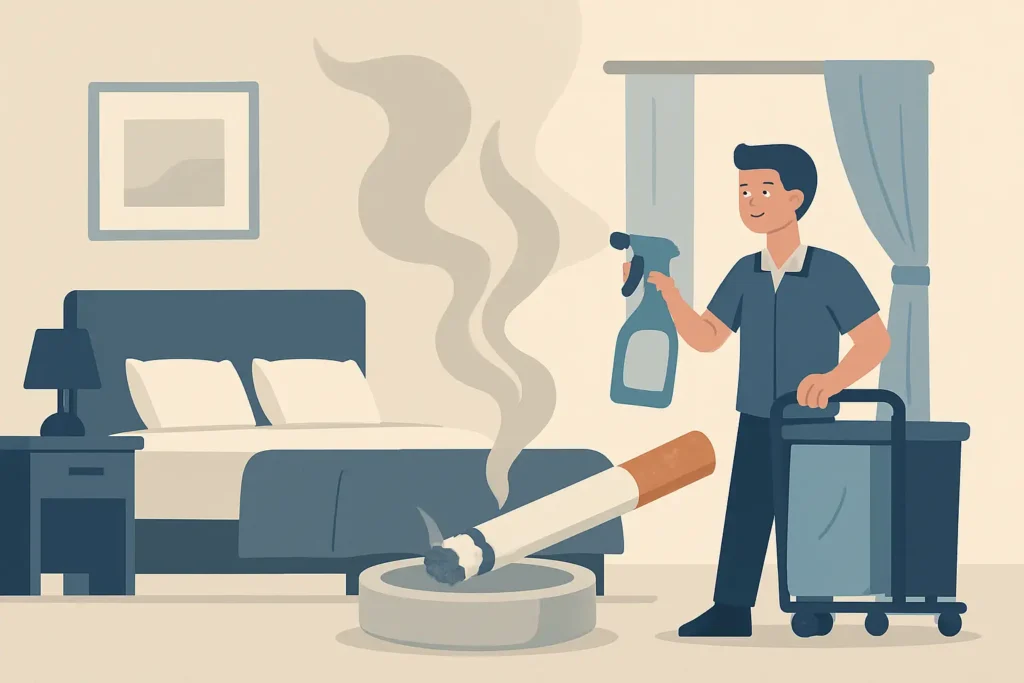
You know the room before you open the door. A guest checks in, drops their bag, and that stale tobacco note hits the back of the throat. They will not call it “a bit smoky”. They will call it dirty, and the review will travel further than your apology.
Tobacco odour is one of the most operationally expensive smells in hospitality because it is not a single smell. It is a mix of tar residues, VOCs and fine particulates that sink into porous materials, then re-emit whenever humidity rises, the fan coil starts, or sunlight warms soft furnishings. If you only mask it, it comes back. If you only clean surfaces, the air still carries it. If you only change the air, the room still bleeds odour from every fibre.
Tobacco smoke smell removal hotel teams can standardise
Effective tobacco smoke smell removal in a hotel is a process, not a product. The fastest results come from treating three layers at once: the deposits on hard surfaces, the reservoirs in soft materials, and the airflow paths that keep redistributing contamination.
The trade-off is simple. The more you rely on manual deep cleaning alone, the more labour you burn and the longer the room stays out of inventory. The more you rely on “quick fixes” like fragrance sprays, the more repeat complaints you generate. The aim is repeatable turnaround that housekeeping and engineering can run without guesswork.
Step 1: Confirm where the smell is coming from
Before you deploy chemicals or equipment, work out whether you are dealing with residual contamination or active ingress.
If the smell is strongest at the door threshold or around the corridor grille, you may be pulling smoke from adjacent rooms or a stairwell via pressure imbalance. If it spikes when the fan coil runs, the coil, drain pan, filter, or ductwork may be holding residues that keep re-aerosolising. If it is strongest at soft touchpoints – headboard, curtains, upholstered chair – you are dealing with absorbed tar and VOCs.
This matters because “cleaning the room” will not fix a building airflow problem. Equally, balancing air will not remove contaminants already embedded in textiles.
Step 2: Remove deposits from hard surfaces first
Tobacco residues form a sticky film that traps other odours. Start with the non-porous surfaces because they are the easiest to reset and they stop cross-contaminating cleaned fabrics.
Focus on ceilings near the fan coil, wall edges, light fittings, glass, mirrors, wardrobe interiors, skirting boards, door frames, and the back of the door. Pay attention to the areas guests touch least – that is where residues quietly build for months.
Use a proper degreasing cleaner suited to hospitality finishes, and rinse where appropriate. Avoid over-wetting plasterboard edges and timber joints. If you are turning rooms quickly, the hidden cost is moisture left in corners, which can feed mould and create the next odour complaint.
Step 3: Treat soft furnishings like odour reservoirs
Curtains, carpet underlay, mattress edges, upholstered chairs, and even decorative cushions behave like sponges. Tobacco VOCs and particulates bind to fibres and then off-gas slowly.
If you have the time window, hot water extraction on carpets and upholstery can lift a lot of the residue, but it can also extend drying time and raise humidity. That is where operators get caught: the room “smells cleaner” for an hour, then humidity rises and the tobacco note returns stronger.
For problem rooms that keep relapsing, be pragmatic. Some items are cheaper to replace than to rehabilitate, particularly if the smell has been baked in by repeated incidents. Curtains and cushions are often the highest impact for the lowest replacement cost.
Step 4: Reset the HVAC path, not just the room
Hotels with fan coils and centralised fresh air often chase tobacco odour in circles because the airflow path is never fully treated. If a guest smokes heavily, contaminants can reach:
- Fan coil filters and coil fins
- Drain pans and wet insulation
- Return air grilles and short duct runs
- Toilet extract paths that backflow under poor pressure control
Change or clean filters, then inspect coil cleanliness and drain pan condition. If you see biofilm, you will also have odour. Tobacco plus microbial growth is the combination that turns “a bit smoky” into “uninhabitable”.
If multiple rooms share ductwork or an air handling unit, you will get faster stabilisation by treating at the system level rather than fighting room by room.
Why “masking” and “waiting it out” fail
Tobacco odour complaints do not come from one molecule. You are dealing with a cocktail of VOCs and semi-volatile compounds that re-emit over time. Fragrance sprays only add another layer of VOCs. Guests read it as cover-up.
Ventilation helps, but it is slow when the source is the room itself. Open windows are rarely a reliable option in modern hotels, and in many UK urban locations, outdoor air can bring in diesel particulates and cooking odours that create a different complaint.
HEPA filtration can remove particulate, but most tobacco smell perception comes from gases and residues, not just free-floating particles. A HEPA unit may improve the feel of the air, yet still leave the room smelling stale because the VOCs are not being actively neutralised.
Ozone generators are often brought up because they can oxidise odours. The operational issue is that ozone is not something you want in occupied guest areas, and misuse creates safety and liability exposure. It is also hard to control distribution into the places where odour sits, like underlay and coil cabinets, without over-treating the air.
A faster approach: neutralise odours in the air while the room dries
Once you have cleaned and extracted what you can, you still need to stop re-emission from taking over again. This is where active air treatment earns its keep.
Bipolar ionisation, when engineered properly, drives a high volume of positive and negative oxygen ions into the space and airflow. Those ions react with odour-causing compounds and reduce the intensity of VOCs, while also helping to agglomerate fine particles so they can be captured by existing filtration. In practice, this can shorten the period between “deep clean done” and “room actually smells neutral”.
The key phrase there is engineered properly. You want systems designed for continuous commercial operation, sized to room volume and air changes, with clear safety credentials. In hospitality, the standard is simple: you cannot create a new problem while fixing the old one.
If you are comparing technologies, check for zero-ozone verification and recognised safety testing. Certifications such as UL2998 (zero ozone) and UL867 are used by procurement teams precisely because they reduce uncertainty.
Portable units are useful when you need a rapid room refresh after an incident. Wall-mounted units make sense for repeat offenders: specific rooms, corridors outside them, lifts, smoking-adjacent entrances, and toilets where odours accumulate. In-duct or HVAC-integrated units are the operational lever when you want building-wide consistency and fewer surprises across floors.
For hotels that want an engineered, low-maintenance option, PurAire manufactures professional-grade bipolar ioniser systems using Glass DBD tube technology, positioned specifically as a zero-ozone alternative to ozone generators and a more active solution than passive filtration.
What “good” looks like operationally
The goal is not to win a one-off battle. It is to stop tobacco smell from blocking inventory and consuming labour.
A workable standard is: after remediation, the room should hold neutral odour after being closed for several hours, not only when it is freshly aired. Test it the way a guest experiences it. Shut the door, switch the fan coil on for a normal cycle, then walk in after the room has been idle. If the odour returns at that moment, you still have either a reservoir (curtains, carpet underlay, mattress, upholstered headboard) or a distribution path (fan coil cabinet, return path, corridor pressure).
From a staffing perspective, the best setups reduce dependence on “that one supervisor who knows what to do”. Document a trigger-based response: what housekeeping does immediately, what engineering checks on the fan coil and pressure, and what equipment gets deployed for active treatment.
The it-depends scenarios hotels should plan for
Not every smoky room is the same, and pretending it is leads to inconsistent outcomes.
If the incident is light and caught quickly, you can often recover the room with surface cleaning, targeted textile treatment, and active air neutralisation within the same shift. If the guest smoked repeatedly over several nights, expect tar film in the fan coil cabinet and deeper saturation in soft materials – that is where replacement of curtains or even carpet underlay becomes financially rational.
If your property has ongoing corridor odour, the “smoke room” may be the symptom, not the cause. Pressure balance, door seals, and extract performance become part of odour control, not separate engineering chores.
And if your hotel is mixed-use with F&B, loading bays, or a smoking area near air intakes, tobacco odour can be coming from outside. In that case, in-duct treatment and intake relocation or shielding can deliver more than repeated room cleaning.
A useful mindset is to treat odour control like any other performance metric: measure complaints, track repeat rooms, and quantify nights lost to blocked inventory. Once you can put a number on it, you can justify the right level of intervention.
A guest will forgive a dated room if it feels clean. They will not forgive a room that smells like someone else’s habit. The best time to fix tobacco odour is before the next check-in, but the most profitable time is when your team can remove it on purpose, every time, without drama.