A lift that smells of yesterday’s takeaway. A guest room with a stubborn damp note even after housekeeping has turned it. A bin room that “comes back” by lunchtime. These are not filtration problems – they are chemistry and surface problems. If your team is already cleaning properly and the odour is still winning, a cold plasma ioniser for odours is worth a serious look.
What a cold plasma ioniser for odours actually does
In commercial buildings, most persistent odours are not floating around as neat, removable particles. They are volatile organic compounds (VOCs) and reactive gases released from sources: urine salts in grout, grease films in extraction routes, mould and mildew metabolites, smoke residue on soft furnishings, and organic decay in waste areas. They off-gas continuously, so the smell returns even if you “clear the air” for ten minutes.
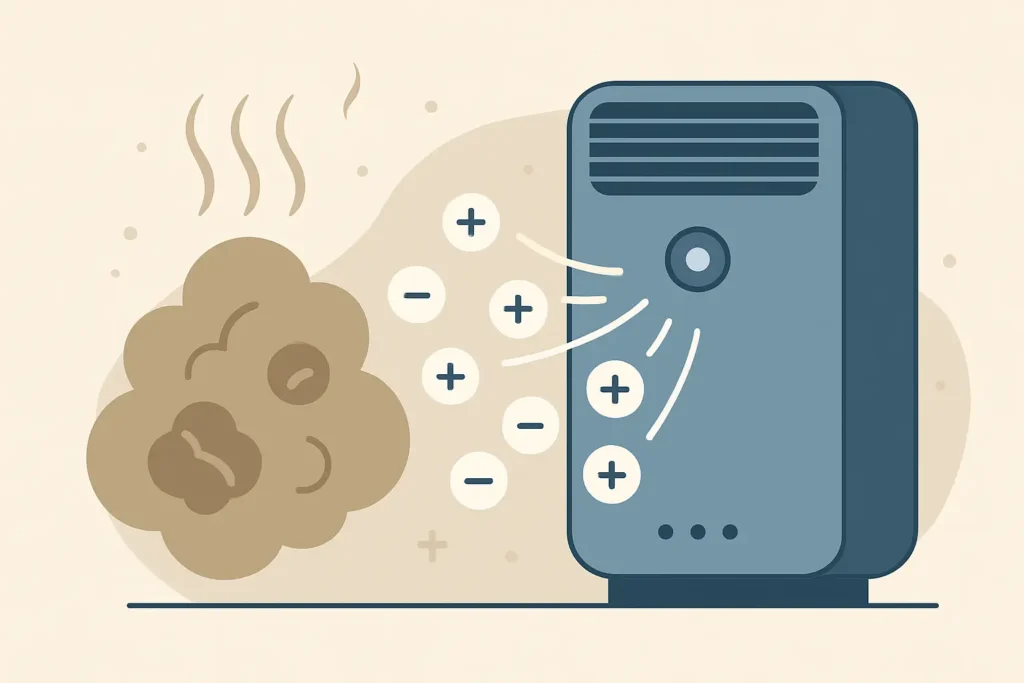
Cold plasma ionisation (often delivered as bipolar ionisation) generates positive and negative ions that react with airborne contaminants. In practice, you are creating a highly reactive environment where odour molecules are broken down and transformed into less odorous compounds. Done correctly, it is active treatment – it does not wait for air to pass through a filter, and it is not limited to whatever happens to enter a box.
This is where cold plasma is different from the tools many sites already have. Sprays and fragrances mask. HEPA removes particles but does not neutralise most VOC-based odours. Ozone can “shock” odours, but it also creates operational and safety issues that reputable facilities teams do not want to own.
Why odour problems persist after cleaning and ventilation
If you are managing hotels, clinics, serviced flats, schools, or F&B venues, you will recognise the pattern: a room is cleaned, ventilated, and signed off, then the next person walks in and complains within minutes. That is because ventilation only dilutes what is airborne at that moment. It does not stop the source from off-gassing, and it does not change the chemistry of the compounds causing the smell.
A cold plasma ioniser for odours targets the volatile compounds and the airborne micro-contaminants that keep odours alive. In real operations, the win is speed and persistence – fewer repeat complaints, fewer re-cleans, and fewer rooms or areas taken out of service.
The big trade-offs: cold plasma vs HEPA, ozone, UVC, and PCO
Facilities teams often inherit a mix of controls. The question is not “what is best”, it is “what solves this odour scenario safely, continuously, and at a sensible total cost of ownership”.
Cold plasma vs HEPA filtration
HEPA is excellent for particulate removal (dust, pollen, some aerosolised particles). For odours, it depends on whether you also have enough activated carbon and enough residence time. Most portable “HEPA” units in real sites are undersized for serious odour removal because carbon beds saturate and require ongoing replacement.
Cold plasma ionisation is consumable-free in the way operators care about – no filter change schedule to keep odours down. It treats the air and, critically, supports reduction of compounds that re-enter the air from surfaces.
Cold plasma vs ozone generators
Ozone generators are often sold as the blunt instrument for smell. They can work, but the operational constraints are the problem: spaces must be unoccupied, treatments are episodic, and you inherit risk questions from staff and guests.
A professional-grade bipolar ionisation approach is designed for continuous occupied-space operation when it is certified for zero ozone. For procurement, that is where UL2998 matters: it is a recognised standard for zero ozone emissions.
Cold plasma vs UVC
UVC can be useful for coil treatment and certain disinfection applications, but UVC is line-of-sight. Odours are not. UVC does not neutralise the full mix of VOCs that cause most commercial smell complaints, and it does not reach into soft furnishings, corners, or voids unless you build an engineered solution.
Cold plasma vs PCO
Photocatalytic oxidation (PCO) products vary wildly. Some create by-products and can introduce their own smell or irritation complaints if poorly designed. If you are specifying for hotels or healthcare, you want predictable chemistry, documented safety, and repeatable performance.
What “good” looks like when specifying a cold plasma ioniser
Not all ionisers are equal. If you are buying for commercial outcomes – faster turnover, fewer maintenance call-outs, fewer complaints – you need to specify like an operator, not like a consumer.
1. Zero ozone certification is non-negotiable
If the device is intended for occupied spaces, insist on UL2998 for zero ozone. If it is installed into air handling equipment, UL867 is also commonly referenced for electrostatic air cleaners. Certifications do not replace good engineering, but they are the baseline for safety confidence and compliance conversations.
2. Ion output and coverage must match the space and the problem
Odour control is about dose over time in the real airflow conditions of the room or duct. A small wall-mounted unit may be perfect for a toilet lobby, lift, or a single guest corridor hot spot. A portable unit is useful when you need rapid deployment for problem rooms and quick wins. In-duct or HVAC-integrated systems are how you treat a whole building continuously – fan coils, air handling units, and ductwork – without chasing complaints room by room.
The dependency is simple: the heavier the odour load and the more porous the materials, the more continuous treatment matters.
3. The tube or cell technology affects durability and stability
Engineering teams care about service life because downtime creates operational pain. Look for robust dielectric barrier discharge (DBD) designs. Glass DBD tube technology is valued because it is stable at high output and does not char or smoulder in the way some composite multicore designs can under harsh conditions.
4. Integration matters: BMS-friendly and low maintenance
For larger sites, you want something that can be deployed as part of building operations, not as a collection of gadgets. In-duct systems that can be integrated cleanly, with predictable power and control, are easier to standardise across a portfolio.
Where cold plasma odour control performs best
Odour problems cluster in predictable places. The most successful deployments are application-led.
Guest rooms and serviced flats
The commercial impact here is immediate: blocked inventory costs money. Cold plasma ionisation is particularly effective for smoke residue, musty odours from humidity, and “lived-in” VOC build-up that ventilation alone never fully clears. Operators use portable units for rapid room refreshes, then standardise with in-room or corridor-level systems where recurring complaints appear.
Toilets, washrooms, and lift lobbies
These spaces are small, high-complaint, and easy to lose control of during peak footfall. A wall-mounted unit can provide continuous neutralisation without relying on fragrances that guests often interpret as “cover-up”.
Bin centres, waste rooms, and back-of-house
Waste odours are a mixture of VOCs and bioaerosols. Treating these areas reduces complaints that travel into guest-facing zones via corridors, service lifts, and pressure imbalances. The operational win is fewer staff complaints as well – which matters for retention and morale.
Clinics, hospitals, schools, and offices
In public-facing environments, odour control overlaps with hygiene perception. When a space smells “clean”, complaints drop and trust rises. Bipolar ionisation also supports airborne pathogen deactivation performance claims in certain validated systems, which helps infection-control narratives – but it must be backed by proper testing and certifications rather than marketing.
What to expect in the real world (and what not to expect)
Cold plasma ionisation is not a magic wand. If you have a true source problem – a hidden leak, soaked carpet underlay, mould behind a wall, or a grease trap failure – you still need remediation. Ionisation supports odour reduction, but it does not replace fixing the root cause.
What it does do is change the day-to-day equation. Instead of a cycle of masking, complaints, and re-cleans, you get steadier baseline air quality and faster recovery after incidents. In hospitality terms, that means fewer guest-room disputes at check-in and fewer “move me” requests that destroy efficiency.
Practical deployment: portable, wall-mounted, or in-duct?
If you are choosing a form factor, start with how the odour behaves.
If the problem is unpredictable and moves around – for example, occasional smoking in non-smoking rooms or sporadic food odours – portable units give you speed and flexibility.
If the odour is localised and constant, such as toilets, lifts, small clinics, or a specific corridor, wall-mounted devices provide always-on control with minimal staff interaction.
If the problem is systemic across multiple zones, or you are managing a large building with shared air, in-duct integration is usually the most efficient approach. You treat the air where it moves, continuously, with the lowest operational friction.
This is the model behind professional systems from brands such as PurAire, which focus on high-output bipolar ionisation using Glass DBD tubes and position UL2998 zero-ozone certification as the safety baseline for occupied spaces.
The procurement questions that separate performance from disappointment
Before you commit, pressure-test the proposal like an engineer and an operator.
Ask how coverage is defined – by room size, airflow, or ideal conditions – and how the supplier sizes for your use case (toilets are not the same as guest rooms, and both differ from ducts). Ask what maintenance looks like in hours and in labour. Ask for certification evidence, not just claims. And ask what success is meant to look like operationally: fewer complaints, reduced time out of service, and measurable reductions in VOC-related odour intensity.
If the answers are vague, performance will be vague.
A closing thought
Odour control is rarely about “fresh air” alone. It is about protecting revenue, reputation, and staff time in the places where smells become complaints. Specify a cold plasma ioniser for odours the way you would specify any piece of building plant: certified for safe operation, correctly sized, and designed to run quietly in the background while your team gets on with the job.