A guest checks in early, drops their bag, and immediately notices it instantly – a faint musty note, yesterday’s curry, a hint of stale smoke from the balcony next door. They will not describe it as “mild”. They will describe it as “dirty”, and that word travels straight to reviews.
Hotels already run on tight turnarounds. The hard part is that odour does not behave like a stain you can point at and remove. It sits in soft furnishings, lingers in bathroom grout, rides on airborne VOCs, and gets recirculated by fan coils and corridor pressure. A proper hotel guest room freshening system is not a can of fragrance and a prayer. It is an engineered approach that treats the air, the surfaces, and the HVAC path that keeps reintroducing the problem.
What “Freshening” Actually Means (And Why Most Systems Fail)
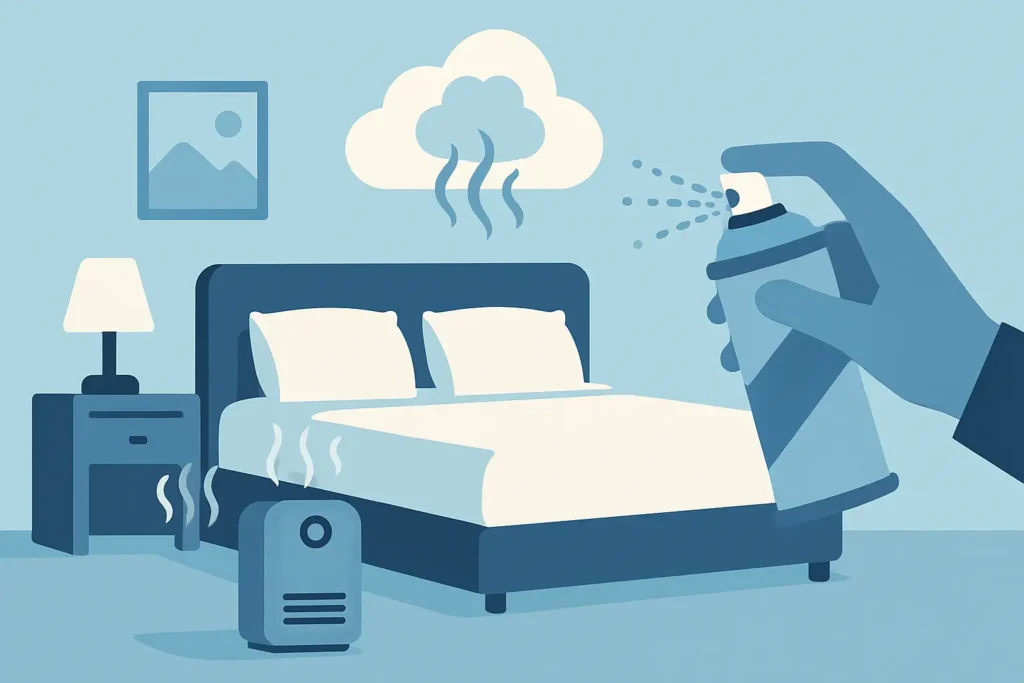
In the hotel world, most “room freshening” is just a polite way of saying we’re hiding something. Whether it’s masking with scents or filtering with passive HEPA units, these methods don’t actually deal with the chemistry of the smell.
Odours aren’t just “smells”—they are a complex cocktail of VOCs and particles. Some are permanent residents (mould, damp, drains), some are guest-driven events (smoke, food, illness), and some are operational side effects (bin rooms or linen trolleys). If your strategy is just moving air or adding perfume, you’re not solving the problem; you’re just delaying the next complaint.
A performance-led system focuses on three non-negotiables:
- Destruction, not distraction: It breaks down odour compounds instead of covering them.
- Growth Control: It actively reduces the mould and mildew that drive the smell. It stops and kills mould spores before they spread
- Safety: It achieves results without introducing new risks to your guests or staff.
Why “Spotless” Doesn’t Always Mean “Odour-Free”
Housekeeping teams are the front line of visible cleanliness—they handle the fabrics, the bathrooms, and the hard surfaces. But odours live where a cleaning cloth can’t reach. In the short window between check-out and check-in, manual cleaning simply isn’t enough to tackle “stealth” odours.
Soft furnishings—carpets, curtains, and upholstered headboards—act like sponges for VOCs, holding onto molecules long after the room looks perfect. Then there are the bathrooms: dry floor traps, pipework biofilm, or damp silicone joints can produce a persistent smell that returns just hours after the team leaves.
Finally, there’s the building itself. In humid climates, fan coils and ductwork become odour reservoirs. If your HVAC is just recirculating VOC-heavy air, you’re reintroducing the guest’s complaint every time the AC kicks in. This is why a real room-recovery system isn’t a “cleaning product”—it’s an essential operations tool.
The Non-Negotiable: Why “Zero Ozone” is the Hospitality Gold Standard
Ozone generators are frequently marketed as a “magic bullet” for smoke, mould, and food odours. While ozone is very effective at breaking down compounds, its use in a hospitality environment requires training and proper deployment.
For hotel operators, guest and staff safety is the primary concern. Traditional ozone treatments require proper usage protocols. For example, you should not have a guest in the room while you’re using the ozoniser, and you need to allow the ozone to revert back into oxygen before your guest arrives. You should also ensure that the ozone generator that you use is designed specifically for guest room use, such as the ProMedUSDA Model UV SG600T36 MiniPro. These models do not produce sufficient ozone to get anywhere close to the NEA safety threshold of 0.05PPM (they typically use about 0.02ppm to freshen a room).
When evaluating air treatment technology, a better solution would be our PurAire bipolar ionisers. In procurement, the UL2998 standard is the benchmark for Zero Ozone emissions, while UL867 ensures the safety of electrostatic air cleaners. Almost every PurAire bipolar ioniser has been tested to meet these standards.
Active Air Treatment: Why Bipolar Ionisation is an Operational Win
Traditional air filters are passive—they wait for the air to come to them. Bipolar Ionisation is active – it’s proactive. It silently sends positive and negative oxygen ions directly into the room or HVAC stream saturating the space with invisible yet powerful ions. This is critical in the real world because odours and pathogens aren’t “polite”—they don’t stay in one corner waiting for a filter box to find them.
A well-engineered bipolar system delivers three key operational wins:
- True Odour Neutralisation: Ions react with VOCs to break down the chemistry of a smell. For you, that means fewer “room smells off” complaints and a much faster turnaround for problem rooms so you can sell them again quickly.
- Mould & Mildew Control: By reducing the airborne microbial load, you stop the cycle of recurring musty smells—the kind that usually creep back hours after a deep clean. PurAire’s bipolar ionisation kills mould spores on contact.
- Pathogen Protection: In hospitality, clean air is about guest confidence and staff wellness. Reducing airborne pathogens helps manage “sick room” incidents and keeps your team on the floor.
The Reality Check: Ionisation isn’t a magic wand for physical dirt. If you have a saturated carpet or a hidden leak, you still need to fix the source. That’s where our Tersano Stabilised Aqueous Ozonated Water comes in – using Tersano’s SAO, kills the mould and mildew directly down to the sour5cs (carpet backing, etc). Chemicals and shampoos cannot do this. Bipolar ionisation provides speed and consistency, but it works best when paired with solid maintenance discipline like Tersano.
Choosing the right deployment: portable, wall-mounted, or in-duct
The fastest way to waste budget is to buy the wrong form factor.
Portable units are for rapid resets and flexible deployment. They are useful for smoke incidents, high-complaint rooms, or after a maintenance job that stirred up odours. They also help when you want to prove impact before committing to a larger roll-out. The operational reality: a portable solution needs ownership. If nobody is responsible for moving it, it will live in a store room. But they are incredibly effective, and we’ve found that housekeepers love how fast they kill those nasty smells. The PurAire DUO is lightweight (1KG) and can easily and quickly handle the smells in a guest suite.
Wall-mounted units make sense for small, persistent problem areas: guest rooms with recurring mustiness, housekeeping closets, toilets, or lift lobbies that hold odour because of low air change. They run quietly, continuously, and remove the “did someone remember to switch it on?” risk.
In-duct or HVAC-integrated systems are the step change. They treat air where it moves – fan coils, air handling units, and ductwork – and keep working 24/7. This is where you reduce cross-room odour transfer and stop the building from recontaminating freshly cleaned rooms. If you have a BMS, integration and monitoring are the difference between a project that sticks and a project that becomes invisible.
In practice, many hotels end up with a layered approach: portable for incidents, wall-mounted for chronic hotspots, and in-duct for whole-floor or whole-building consistency.
What to look for in equipment: performance, durability, and total cost
Selecting Equipment That Actually Lasts
In hospitality procurement, the cheapest unit is often the most expensive to own. Cheap products simply aren’t built to last – you do indeed get what you pay for… and they usually break down just when you need them!To ensure a return on your investment, look for three things:
- Low Maintenance: Avoid devices with complex consumables. If it’s hard to clean, it won’t get cleaned. You want a durable system with a long-life generation tube that provides consistent performance for years, not months. PurAire models like our PurAire DUO require virtually zero maintenance.
- Safety-First Engineering: Insist on Glass DBD tube technology. Unlike composite tubes that can smoulder, char or degrade over time, glass tubes remain stable under the high-stress conditions of continuous hotel operation. Glass does not burn – multicore composite tube unfortunately can.
- Realistic Coverage: Square metre ratings on a box rarely account for “real-world” factors like heavy soft furnishings, bathroom moisture, or high ceilings. Ensure your system is sized for your specific room volume to avoid under-performance. We will guide you in selecting the best product for your needs.
- Stealth Operation: If a guest can hear it or see it, they can complain about it. The best systems are those that work silently in the background. Ours are virtually silent.
The Business Case for Air Quality: Turning Complaints into Inventory
In the high-stakes world of room inventory, an odour is a “blocked” room. You can’t sell it. To keep your floors profitable, you need a system that functions without constant oversight.
1. Stop Reacting, Start Categorizing
Predict your problems. Rooms with plumbing issues or balcony smoke drift are high-risk. By installing continuous treatment in these specific units, you prevent the complaint before the guest even checks in. Our PurAire Model FCU/2 and FCU/3 have been designed precisely for these situations.
2. Standardize the Response
Treat an odour incident like a maintenance emergency. Create a fixed workflow: find the source, remediate the physical cause, and run an engineered air treatment cycle. This professionalizes the response and ensures the room is ready for the next arrival with total consistency.
3. The Bottom Line
Stop tracking “smells” and start tracking “out-of-service nights.” When you reduce the time a room sits empty because of a musty scent or stale smoke, you are directly increasing your RevPAR.
How this compares with HEPA, UVC, PCO and fragrance systems
Hoteliers are often overwhelmed by technical jargon. Here is a breakdown of the common players in the market:
- The Passive Trap (HEPA): Filters catch dust, but they don’t “fix” air. They rely on air passing through them, and they do nothing to stop the chemistry of an odour. Plus, the logistics of changing filters across 200+ rooms is an operational nightmare and very expensive.
- The Safety Constraint (UVC): UVC is great for coils, but risky for rooms. Because it requires a direct line of sight to work, any shadow becomes a “safe zone” for pathogens and odours. If the UVC cannot see it, or isn’t in extremely close proximity to the source of the odour or contaminant, it’s useless.
- The “By-Product” Risk (PCO): Not all PCO is created equal. Some catalysts can react with indoor air to create new, unwanted chemicals. Most PCO units use an ozone generating tube with a Titanium Oxide plate underneath the tube… this emits ozaone and titanium dioxide (Ti)2) is now recognised as a potential carcinogen. Always demand third-party testing for real-world environments.
- The Branding Blunder (Fragrance): Sprays and gels are for masking. To a guest, a scented room that still smells “off” is a sign of a dirty hotel trying to hide its tracks. And frankly… many scents contain chemicals that can trigger allergic reactions, especially in children.
- If you want an engineered, hospitality-ready approach, PurAire builds professional bipolar ioniser systems across portable, wall-mounted and HVAC-integrated formats, using Glass DBD tubes and focusing on zero-ozone safety with UL2998 and UL867 certifications. For properties that want to treat single rooms, toilets, lifts or whole buildings without consumables, that matters operationally and financially. More detail sits at https://Www.PurAire.sg.
The bigger point is not the badge on the casing. It is choosing a system you can run continuously, safely, and quietly – and then integrating it into how your hotel actually turns rooms.
The decision that separates “less smell” from fewer complaints
Odour control is only valuable when it changes guest behaviour: fewer front desk calls, fewer room moves, fewer refunds, and fewer one-star reviews that mention “musty” or “smelled like smoke”. That is why the best hotel guest room freshening system is the one your team can deploy without drama, your engineers can support without constant parts chasing, and your management can justify with numbers.