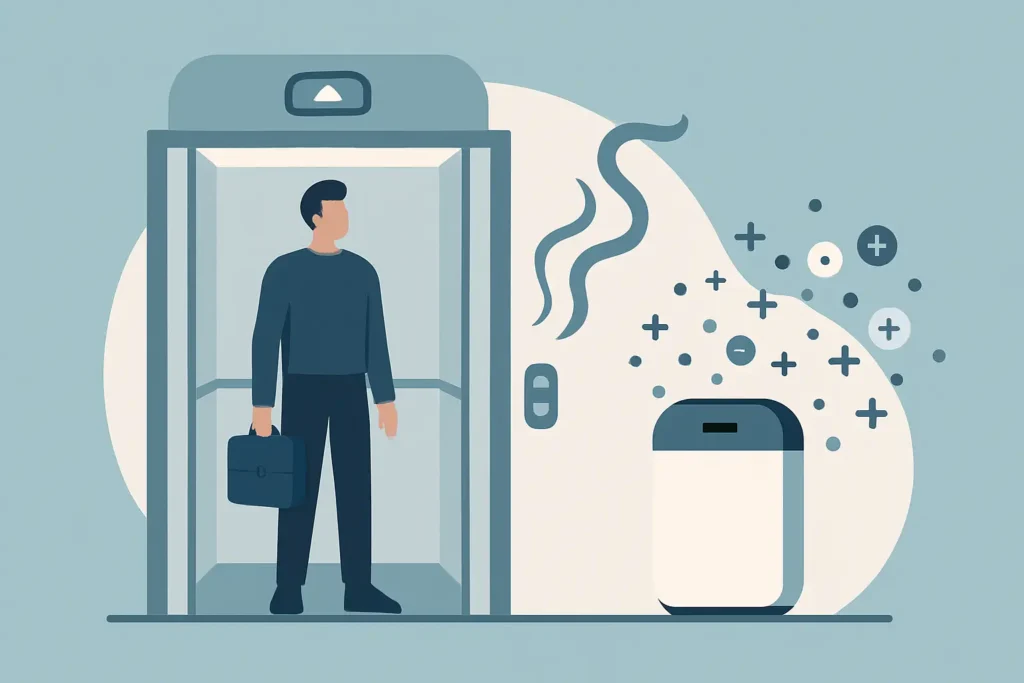
You do not need a lab report to know when a lift smells wrong. Guests step in, doors close, and you have 10 seconds of trapped air to either reassure them or lose them. In hotels, malls, hospitals and offices, lift odour is one of those tiny operational failures that punches above its weight – because it happens at the exact moment people are forced to notice.
A lift odour removal ioniser is one of the few controls that can run silently, continuously and without consumables in a space you cannot practically “deep clean” every hour. But not all ionisers behave the same, and lifts are unforgiving: small volume, heavy traffic, mixed odour sources, and high expectations.
Why lifts smell worse than corridors
A lift is a pressure box with churn. Doors open to a corridor, then to a car park, then to a kitchen floor, then to a bin room-adjacent service lobby. Each stop swaps a slug of air and drags in a different set of gases and particles. You get a build-up of VOCs (volatile organic compounds) from perfumes, food, cleaning agents, off-gassing plastics, damp textiles, and sometimes urine or waste odours tracked from public areas.
Unlike a guest corridor, the lift has limited dilution. Many lift cars have little or no meaningful fresh-air supply. Even when an extract fan exists, it often moves too little air to deal with peak loading, and it does nothing to neutralise odour molecules already present on surfaces.
That last point matters. Odour is not only “in the air”. It sits in porous and semi-porous materials: rubber floor edges, door seals, ceiling panels, cab wall coverings, and the microscopic grime film that builds up on stainless steel from fingerprints and cleaning residues. If you only chase airflow, you often end up playing whack-a-mole.
What a lift odour removal ioniser actually does
Bipolar ionisation works by generating both positive and negative oxygen ions that disperse into the space. In practical terms, you are not masking odours. You are driving oxidation and molecular breakdown reactions in the air and on surfaces, reducing the VOC load that people perceive as “smell”.
You also get secondary benefits that operators care about: reduction of fine particles (through agglomeration and easier capture by existing filtration elsewhere in the building) and support against mould and mildew conditions where humidity and organic residues combine.
The trade-off is straightforward: ionisation is an active chemistry tool. That is exactly why it can outperform passive approaches for odour. But it also means you must specify it properly, select certified zero-ozone equipment, and install it where it can circulate rather than being blocked behind decorative panels.
Why lifts defeat sprays, gels and “nice smells”
Fragrance-based solutions can be tempting because they are fast and visible. The problem is they rarely reduce the underlying VOCs. They overlay them. In a confined lift, mixing odours can be worse than the original smell, and you also risk triggering sensitivities for guests, patients or staff.
Even aggressive cleaning regimes struggle because the lift is always in service. You clean at 06:00, then by 09:00 you have food delivery trolleys, wet umbrellas, perfume clouds, and a rush of footfall. A continuous control is the only option that matches the operating reality.
Ioniser vs HEPA vs UV-C: what actually fits a lift
HEPA filtration is excellent for particles, but odour molecules are gases, not particles. Unless you add a substantial carbon stage (and replace it), HEPA does little for smell. In a lift car, you also have tight space constraints and noise limits. A filter unit that can genuinely move enough air can be obtrusive.
UV-C can help with microbial inactivation in controlled duct or chamber applications, but it does not inherently neutralise the VOCs that drive odour complaints. UV-C in a lift car also raises practical issues around shielding, maintenance access and ensuring the lamp output stays effective over time.
Ozone generators can “work” on odour by brute-force oxidation, but that comes with a safety and compliance problem. Ozone is a respiratory irritant. For occupied spaces, it is the wrong tool. Facilities teams end up running ozone units out of hours, then ventilating, then hoping the level is safe before people re-enter. That is not a professional, repeatable process.
A properly specified bipolar ioniser system is designed for occupied, continuous use – and when it is independently certified to zero ozone (UL2998) and meets UL867 requirements, it gives engineering and H&S teams a clearer compliance story.
What to look for in a lift odour removal ioniser
Start with the two questions that stop expensive mistakes.
First: is it genuinely zero ozone? Do not accept vague “ozone free” marketing. Look for UL2998 zero ozone validation and UL867 electrical safety. If you are putting something in a lift, it will run near people all day. Certifications are not paperwork. They are risk control.
Second: is the ion output high enough for the volume and traffic? Many small “consumer” ionisers are underpowered, or their performance drops quickly with poorly designed emitters. In a high-churn micro-environment like a lift, output and stability matter.
Then assess durability. Ionisation tubes and emitters are not all built alike. Glass DBD (dielectric barrier discharge) tube technology is engineered to deliver high ion generation without the charring and degradation you see in some composite or multicore designs. In practical terms, that means more consistent performance and less downtime.
Sizing and placement: where lift projects succeed or fail
Lifts are usually small by square metres but brutal by usage. You are treating both air volume and event frequency. A small guest lift that runs constantly during check-in can need more active treatment than a larger service lift used occasionally.
Placement matters as much as rating. The ion stream must enter the cabin air and circulate. If the unit is hidden behind a panel with minimal airflow, you may tick an installation box but get weak results.
Most sites land in one of two approaches:
In-cabin, wall-mounted treatment
This is the direct method. You treat the air where the complaint happens. It is ideal when the odour is localised to the cabin, or when air exchange is minimal. The key is to mount the unit where it cannot be blocked, vandalised or routinely wiped with harsh chemicals. Facilities teams also like it because it is easy to inspect.
Treating the lift air path or adjacent lobbies
Sometimes the lift odour is not “from the lift”. It is being pulled in from a car park, a loading bay, a toilet lobby, or a refuse route. In that case, you can improve outcomes by treating the source zone as well as the cabin. Ionisation is not a substitute for fixing a sewage vent leak or a damp ingress issue, but it can reduce odour transport while you address root causes.
Commissioning: how to get measurable results fast
If you are doing this professionally, you want a before-and-after story that stands up in a meeting.
Start by mapping complaint patterns: which lift, what time, what adjacent floors, and what triggers (rainy days, weekend F&B peaks, bin collection time). Then walk the lift route and identify likely sources: damp mats, trolley storage, nearby toilets, grease odours from a kitchen floor, or stale air in a lobby.
After installation, expect an early improvement in perceived odour within hours if the smell is primarily airborne VOCs and traffic-related. Surface-embedded odours can take longer because you are reducing the source reservoir over repeated cycles.
If results are inconsistent, it usually comes down to one of three issues: the unit is undersized for peak traffic, placement is restricting airflow, or the real source is outside the lift and keeps reloading the space. That is not a failure of ionisation as a category. It is a commissioning problem.
Maintenance and total cost of ownership
Lifts do not tolerate maintenance-heavy devices. Filters that need frequent replacement, liquids that spill, or devices that make audible noise will get switched off by annoyed operators or passengers.
A professional bipolar ioniser is typically low maintenance: periodic inspection, simple cleaning where relevant, and scheduled tube replacement based on rated life. That matters commercially because it keeps your odour control consistent and predictable. If you are running multiple lifts across a property portfolio, predictability is the difference between a system and a recurring fire drill.
Safety, compliance and occupant perception
Odour control can backfire if occupants feel you are “pumping chemicals into the air”. That is why the safety narrative must be clear. Specify equipment validated to produce zero ozone, document where it is installed, and ensure the device is appropriate for occupied spaces.
Also be realistic about sensitivities. Even when a system is zero ozone, some environments such as certain clinical areas may require additional stakeholder engagement and monitoring. The benefit of engineered, certified systems is that you have a defensible position with clear standards, rather than guesswork.
A practical deployment path for facilities teams
If you manage a hotel, hospital, mall or office tower, the fastest way to value is to start where complaints and reviews concentrate: the guest lifts and the lift that links to car parks or service routes.
For small problem areas like lifts, toilets and guest corridors, PurAire supplies professional-grade bipolar ioniser units and engineered solutions designed around Glass DBD tube technology and UL2998 zero-ozone validation. If you need help with sizing and placement across multiple lifts and lobbies, start with the application-led guidance at https://Www.PurAire.sg.
The best lift odour removal ioniser projects do not chase perfection on day one. They remove the day-to-day smell that triggers complaints, then they tighten the system by addressing sources, improving airflow where possible, and standardising maintenance so the lift stays “neutral” without anyone thinking about it.
A lift should smell like nothing. When you achieve that, you have not just fixed air – you have protected the moment people decide whether your building feels cared for.