Smoke smell is not a single problem. It is a mix of airborne particles, sticky tar residues on surfaces, and volatile organic compounds (VOCs) that keep off-gassing long after the visible haze has gone. That is why a room can look “fine” after housekeeping, yet the first guest who walks in still catches it at the door.
A portable ioniser can be the difference between a room that turns over today and a room that keeps getting moved to “do not sell” because complaints keep coming back. But only if you buy the right type, size it properly, and use it in a way that matches how smoke odour actually behaves.
What a portable ioniser for smoke smell is really doing
When operators say “smoke smell”, they often mean three things: the air is carrying fine particulate, the soft furnishings and paintwork are loaded with residues, and VOCs are continuously re-released as the room warms up or humidity changes.
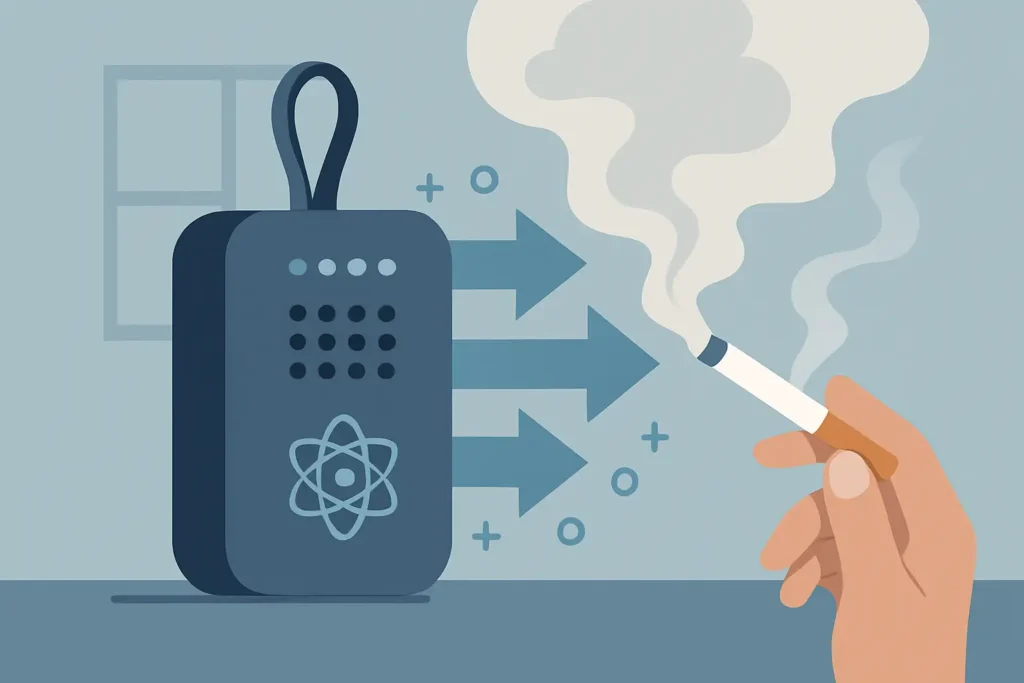
A portable bipolar ioniser targets the air chemistry, not just air volume. It generates both positive and negative oxygen ions that actively interact with odour molecules and airborne contaminants. In practical terms, that means odour compounds are broken down and particles are encouraged to agglomerate, making them easier for normal ventilation and housekeeping to remove.
This is a different mechanism from a passive filter box. A HEPA unit can be excellent at capturing particulates that pass through the filter, but it does not neutralise odour molecules in the room. With smoke, the “smell” often remains even when particle counts improve.
It is also different from ozone generators. Ozone can oxidise odours, but it is not a safe, occupied-space solution and brings operational risk, compliance anxiety, and the overhead of room shutdown protocols. For hospitality, healthcare, and public-facing environments, that trade-off is rarely worth it.
Why smoke odour is so persistent in real buildings
Smoke odour clings because it has multiple reservoirs. You will find it in curtains, mattress edges, carpet underlay, soft seating, grout lines, skirting boards, and even in return air paths. If a room has negative pressure relative to a corridor, smoke-laden air can migrate into adjacent spaces and then cycle back through fan coils.
That matters because a portable unit is often deployed as a “quick fix” after a complaint, while the underlying cause is still active: a guest smoking in the bathroom extract path, a staff smoking point near an intake, or a stale corridor that keeps recontaminating rooms.
The correct expectation is not “one device, one hour, problem solved forever”. The correct expectation is faster recovery, fewer repeat complaints, and a controllable process you can operationalise.
Portable vs in-duct: choosing the right tool for the job
Portable units are built for speed and flexibility. They are ideal when you need to triage a problem room, refresh a guest room between stays, or stabilise an area while engineering investigates the source.
In-duct or HVAC-integrated ionisation is built for continuity. If smoke odour is showing up across multiple rooms, lifts, corridors, or zones served by the same air handling path, treating only the symptom room can become a daily firefight. Treating the airstream at the fan coil or AHU is usually the more economical operational decision because you are preventing reintroduction.
Wall-mounted units sit in between. They are a good answer for recurring hotspots: toilets, bin rooms, lifts, housekeeping cupboards, or clinic waiting areas where “small space, constant odour load” is the pattern.
What to look for in a portable ioniser for smoke smell
You are buying performance, not a gadget. Four factors separate professional-grade equipment from consumer devices that sound impressive but underdeliver.
First is ion output and coverage that matches real room sizes. If the unit is sized for 15-20 square metres and you deploy it in a 35 square metre suite with a corridor, you will get slow results and inconsistent guest feedback. Coverage claims should be stated clearly, with a model range that allows you to match common room types.
Second is zero-ozone assurance. Many “ionisers” are vague about by-products. For commercial deployment, you want documented compliance, typically via UL2998 for zero ozone emissions, and where applicable UL867 as part of electrical safety and air cleaning equipment evaluation. If your team has to debate whether a unit is safe to run around staff, it will not be used consistently.
Third is durability of the ionisation source. Tube technology matters because it dictates stability of output and maintenance cycles. Glass DBD (dielectric barrier discharge) tubes are engineered to deliver high volumes of ions without the charring and smouldering risk seen in some composite tube designs. In a hotel or clinic, reliability beats clever marketing every time.
Fourth is total cost of ownership. Filters, cartridges, and fragrance consumables add up, and they also add failure points. A low-maintenance, 24/7-capable ioniser designed for continuous use is usually the cheaper tool over a year, even if the purchase price is not the lowest.
How to deploy a portable unit for faster, repeatable results
Smoke odour removal becomes predictable when you treat it like a process, not an emergency.
Start with airflow and isolation. Close the room, shut the door, and minimise traffic in and out. If the room has a fan coil, set it to a mode that supports mixing without pulling contaminants from corridors. If the corridor is the source, you do not want to “wash” that air into the room while you are trying to clear it.
Next, address the surfaces that keep feeding the smell. If housekeeping only changes linen and vacuums, you will get a brief improvement and a fast rebound. Wipe hard surfaces where smoke residues settle, pay attention to soft furnishings, and consider whether curtains and carpet underlay are acting as the main reservoir. The portable ioniser accelerates what you are doing by neutralising odours in the air and reducing reactivity, but it cannot scrub tar out of fabric by itself.
Then run the ioniser with the correct dwell time. In many rooms, the difference between “still smells” and “guest-ready” is simply enough operating time at the correct output for the volume. If you are turning rooms quickly, build a standard operating window into housekeeping scheduling rather than waiting for a complaint to trigger action.
Finally, verify in a way that makes sense for your operation. Your nose is a valid instrument, but it is subjective and adapts quickly. Where smoke incidents are frequent, pairing your process with basic IAQ checks (VOC trends, PM2.5, or even complaint rates by room) gives you evidence you can use with ownership and brand teams.
The trade-offs: when an ioniser is not the whole answer
There are scenarios where a portable ioniser will help but will not fully resolve the problem.
If the smoke source is ongoing, you will be treating symptoms. That could be a balcony smoking policy that is not enforced, a staff entrance that feeds smoke into a return air grille, or a neighbouring tenancy. In these cases, continuous treatment in the affected air path and a policy fix usually outperforms repeated portable deployments.
If the room has deep contamination from long-term smoking, remediation may be required. Painting, replacing soft furnishings, and addressing duct contamination are sometimes the only way to stop persistent off-gassing. A portable unit is still useful during remediation to reduce downtime and keep adjacent rooms stable.
If you need particulate control for sensitive environments, filtration still matters. Bipolar ionisation addresses odours and airborne microbes differently to HEPA, but it does not replace the role of filtration in high-risk clinical pathways. Many facilities run both because they solve different problems.
Why operators choose bipolar ionisation over “masking”
Masking sprays and fragrance diffusers are tempting because they are immediate. They also create a second odour profile, and guests notice. In a review culture, “room smelled of smoke and air freshener” is worse than “room smelled of smoke”.
Bipolar ionisation is chosen because it is source-oriented. It aims to neutralise and reduce the compounds that create odour, rather than hiding them. Operationally, that means fewer callbacks, fewer room moves, and less front desk time spent firefighting.
A note on professional-grade options
If you are specifying for hospitality, clinics, or multi-site operations, look for a range that covers portable, wall-mounted, and HVAC-integrated deployment so you can standardise training and spares. PurAire is one example of a brand that builds professional-grade bipolar ioniser systems around Glass DBD tube technology and positions them with UL2998 and UL867 zero-ozone assurance for occupied-space confidence (https://Www.PurAire.sg).
The operational payoff that actually matters
Removing smoke smell is not about winning an argument on technology. It is about protecting sellable inventory and preventing reputation damage. A single smoky room can trigger a chain reaction: room moves, compensation, housekeeping rework, engineering callouts, and one more review that management has to respond to.
A properly selected portable ioniser gives you speed and control. The best outcome is not that you “never get smoke incidents”. The best outcome is that when they happen, you recover fast, your team has a repeatable playbook, and the guest never feels the disruption.
Treat smoke odour like you treat any other performance metric in the building: measure the pattern, fix the source where you can, and keep a tool on hand that turns a problem room back into revenue without drama.