How to Stop Persistent Mouldy Smells in Singapore Buildings: An Operations-First Guide The worst mouldy smell isn’t the dramatic one you notice the moment you walk in. It’s the nasty, persistent mustiness that clings to soft furnishings, reappears immediately after housekeeping, and triggers endless guest complaints.
For those managing guest rooms, clinics, or commercial facilities in Singapore’s high humidity, “mouldy rooms” mean more than just a bad smell—they result in blocked inventory, wasted labor, and damaged reputations.
If you’re tired of “masking” odors with fragrances, here is the practical, operations-first guide to removing mouldy smells and ensuring they never return.
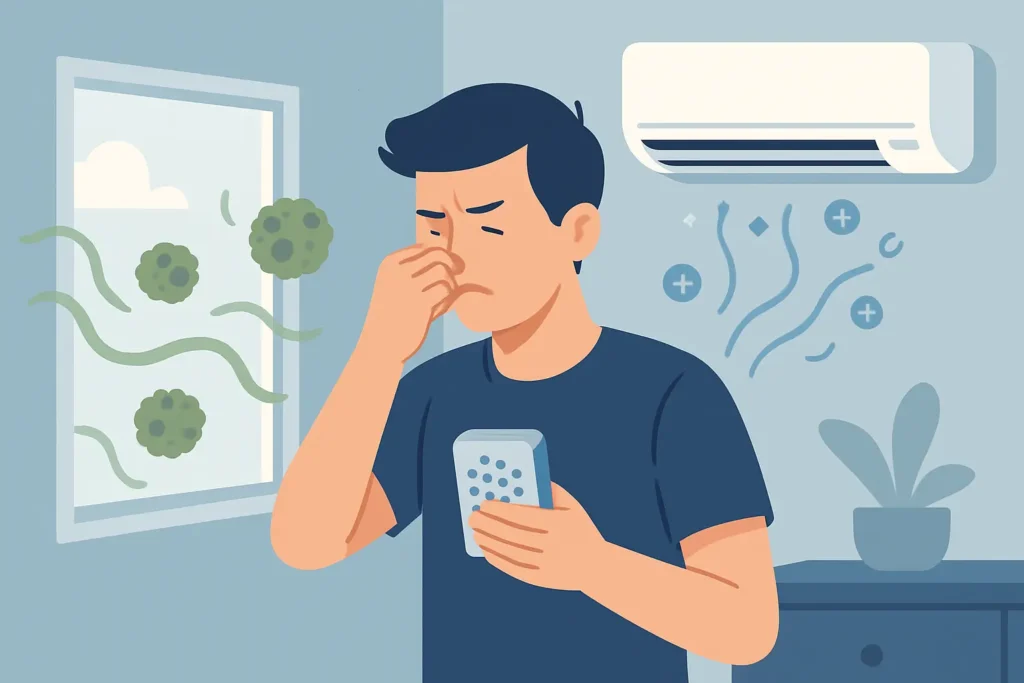
Why Mouldy Smells Linger (Even After Cleaning) That “damp” odor is caused by Microbial Volatile Organic Compounds (mVOCs). These are gases produced by mould and bacteria as they grow. While the gases travel through your ventilation, the spores themselves embed deep into porous materials.
Wiping a surface isn’t enough because the source is often hidden:
Embedded Spores: Hidden in carpets, curtains, and mattress edges.
Wall Cavities: Moisture trapped behind skirting boards or vinyl wallpaper.
The “Singapore Factor”: With our relentless humidity, mould is proactive. Your solution must be more proactive than the growth.
Step 1: Locate the “Boring” Hidden Sources In commercial environments, mould rarely starts in the middle of the room. Look where the air stays still or the water stays wet:
FCUs & Condensate Trays: Biofilm buildup and clogged traps are primary culprits.
Ceiling Voids: Slow leaks or “sweating” pipes above the tiles.
Thresholds: Capillary moisture trapped under vinyl or carpet edges near bathrooms.
External Walls: Wardrobes placed against cold external walls create micro-condensation.
Step 2: Deep Clean with Stabilised Aqueous Ozone (SAO) Standard chemicals often leave residues that can actually feed certain types of microbes. Instead, use Tersano’s Stabilised Aqueous Ozonated Water (SAO).
Hard Surfaces: SAO disinfects and deodorizes tiles, metal, and glass without rinsing.
Porous Materials: This is where Tersano shines. Unlike many cleaners, SAO can penetrate fabrics, upholstered headboards, and carpets to kill mould spores at the root without damaging the material. It is chemical-free, sustainable, and more cost-effective than traditional cleaning detergents.
Step 3: Address the Air Pathway (Beyond HEPA) Many operators rely on HEPA filters. While useful, HEPA is a passive technology—it only catches what happens to float through it.
The Flaw: Mould spores can be smaller than what some filters catch. If trapped, they can actually breed inside the filter, turning your purifier into a source of the smell.
The Solution: You need to treat the air in the room, not just the air that passes through a box.
Step 4: Stop the “Fragrance Fail” Masking sprays are a red flag to guests. A perfumed room with a damp undertone signals a “cover-up.” Furthermore, many synthetic fragrances contain VOCs that can be toxic or trigger respiratory issues in sensitive patients or guests. If a guest smells heavy perfume, they often immediately ask for a room change.
Step 5: Switch to Proactive Bipolar Ionisation To keep a room “inventory-ready” 24/7, you need proactive air treatment.
PurAire Bipolar Ionisation systems work by saturating the air with positive and negative oxygen ions. These ions actively seek out and neutralise mould molecules and odors in the air and on surfaces.
Why Operators Choose PurAire: Continuous Protection: It works silently 24/7 to kill spores before they settle.
Zero Ozone Safety: Our systems are certified to UL2998 (Zero Ozone) and UL867 standards.
No Consumables: Unlike HEPA, there are no expensive filters to change or dispose of.
Deployment Flexibility: We offer portable models for rapid room recovery, wall-mounted units for toilets, and in-duct units for building-wide AHU/FCU treatment.
The Bottom Line: Protect Your Revenue Mouldy smells are a performance signal. When you combine the deep-cleaning power of Tersano SAO with the continuous protection of PurAire Bipolar Ionisation, you aren’t just cleaning—you are protecting your revenue stream.
Stop blocking rooms and start clearing the air.
Ready to recover your “smelly rooms”? Contact the PurAire team today for an application assessment and sizing guide